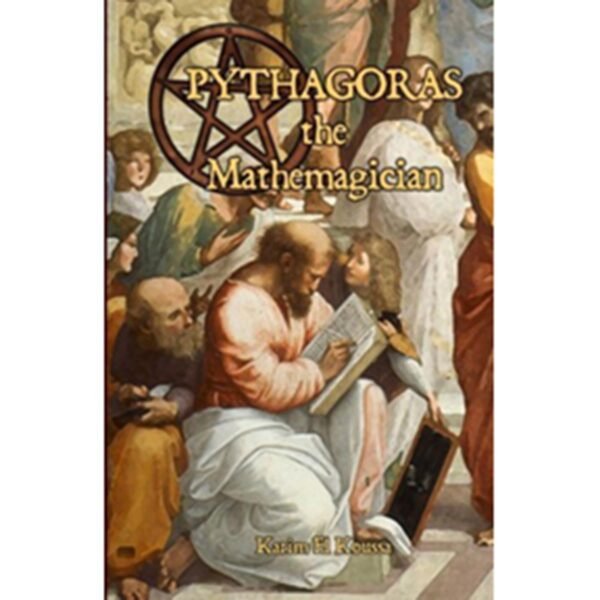

Pythagoras: The Mathemagician


Original price was: $29.95.$7.50Current price is: $7.50.
Pythagoras: The Mathemagician
Additional Information
- Description
Description
By Karim El-Koussa
r
Pythagoras was born in Sayda, r
from a Tyrian father and a Saydonian mother. The parents received a prophecy r
at the temple of Delphi, in Greece, revealing the coming of a child, who would r
be a kind of a saviour to mankind. The child grew up, surrounded by his father r
who taught him about ships, the geography of the Mediterranean Sea, and trading. r
His father was a merchant who sailed a lot between Phoenicia and Greece, taking r
the child with him. He later was taught poetry and music, geometry and astronomy r
by wise men, especially Thales and his uncle Pherecydes. The family had a house r
at Samos, where sometimes would live in. They were always travelling around r
the Mediterranean.
r
Pythagoras, after he had his early years of formation, went to Phoenicia where r
he was instructed in the secret teachings of the priests of Jebel, Sayda, Sur r
(Tyre)…and Mt.Carmel.
r
Later on, he sailed to Egypt r
where he received his Major Initiation at Memphis and the Pyramids.
r
They continued up a ladder that r
leads first to the basement of the Great Pyramid, then through passageways until r
they have reached the King’s Chamber. Inside, at the heart of the Pyramid, were r
waiting three other Hierophants wearing white tunics, overshadowed with purple r
robes. One of them was wearing on his head a crown with two horns and a globe r
in the middle representing the Moon. The other, a crown with the eye of Ra, r
the Sun, while the third, a crown having a serpent on its front, representing r
the vital energy that must be elevated by Pythagoras. It was their usual outfit r
at ceremonies of Initiation. They were standing on the three other sides of r
the sarcophagus, holding torches in their hands, illuminating the Chamber. The r
fragrance of incense dispersed in it. -"No one can escape death, but every r
spirit is destined for a resurrection. You will sleep in this sarcophagus for r
three days and three nights, Pythagoras, and wait for the light of Osiris." r
The High Priest uttered mystically and it vibrated in the Chamber.
r
Pythagoras lay inside it, his r
arms crossed on his chest. The Priests, after chanting few words, each one at r
his turn, blessed him with their hands and left the room. In complete darkness, r
in silence, the cold breeze of the Chamber entered his body. Little by little, r
his vibrations got faster, his heartbeat pumped harder. Pythagoras started to r
lose conscience of his material body, he felt light and he was elevating, not r
in body, but the ethereal part of his being ascended throughout the gateways r
of eternity. Pythagoras’ Kha, or so as to say, his spirit flew, like a Phoenix r
bird through the spiritual spheres of space. He found out that life beat all r
around him, that evolution is an eternal law. He saw shapes and numbers. He r
witnessed his past lives.
r
On the third day, in that deep r
mystical space he entered, something unknown was shining. Pythagoras approached r
it, as it approached him. It was a star, a five-pointed star. They have merged. r
A great magnetic light was diffused into the realm of darkness. Pythagoras realized r
that he became the Microcosm of the Macrocosm, the god in the heart of God. r
Suddenly the vision disappeared, and he started to feel his limbs. He was back r
into his body, great weight fell on his head. He opened up his eyes. Around r
him the Hierophants were waiting. They gave him something to drink, and he rose r
up from his tomb.
r
-"Here you are now, resurrected, r
and have experienced the Great Mystery. You have defeated death and achieved r
actual immortality." The High Priest, Sonchis, uttered in a happy voice r
and Pythagoras was looking at him now with the eyes of the wise. -"Come r
on with us to celebrate the glory of the Initiates. You have become one of us, r
a reborn."
r
They went now to the entrance r
of a gallery and they have waited. At the precise moment when the beam of the r
Rising Sun struck full on the face of Pythagoras, the Hierophant initiated him. r
r
-"You will realize now r
that He is in You and that You are in Him. You are everything that is, everything r
that was, and everything that will be. You have become what you are."
r
Later on, Pythagoras was driven r
out of Egypt into Babylon as an exile, or a religious prisoner. There, he was r
informed in the secret s of the Zoroastrians, Chaldeans and the Gymnosophists. r
r
He, later, went to Samos, his r
second country. He wanted to start on his mission. At Samos, he was not accepted, r
so he formed a semi-circle, teaching them about life and its mysteries.
r
His vision of establishing a r
school of Initiation, however, became reality in Crotona, one of the noblest r
cities in Italy. Pythagoras divided his followers, who were forming the Pythagorean r
Society into two circles, the esoteric, called the mathematikoi, and the exoteric, r
called the akousmatikoi. His system of Initiation was composed of 4 degrees: r
1st Preparation (2-3 years), 2nd Purification (3-5 years), 3rd Perfection, and r
4th Baptism by the light of El-Apollo.
r
The Master taught morality, organizing r
the people in the Society, creating a balance in their life. He made Justice r
a living fact, and guided the youth in their cultivation of knowledge. He invited r
them to be philosophers, as he was the first Philo-Sophia, (Lover of Sophia). r
Friendship was one of the essential traits that characterize the Pythagoreans. r
They lived a common life, as true brothers and sisters.
r
In the sequence of his thinking, r
Pythagoras set the basic concepts of his doctrine: 1st the belief that man reflects r
the whole universe within himself. 2nd the belief in the immortality of the r
soul. 3rd the belief in reincarnation and transmigration of the soul, in short, r
metempsychosis.
r
Pythagoras was trying to imitate r
the Kosmic Kingdom (the harmony of Spheres) on Earth, creation a harmony, first r
in his City, then to be spread in neighbouring cities, then, all over the globe. r
The Dodecahedron, or the Ether (Heaven), was on the Cube, the Earth.
r
His vision was universal. He r
made them realizes that the end of them is to become like God! The Master said r
that Number is the measure or the essence of all things, initiating the disciples r
of his inner circle the theology of numbers. He also taught them Cosmology (Heliocentric r
system, …) and the theology of the Psyche.
r
Pythagoras Married Theano, one r
of his disciples. They brought two children to life, who later continued the r
mission of their father.
r
In around 500 Bc, Pythagoras r
was dead from a fire at the Temple of the Muses, due to a terrorist attack by r
the aristocratic lobby of Crotona, led by Kylon.
r
His Psyche, however, resurrected r
his spirit high to eternity, to the Central Fire, the Great Monad.
r
Jacket Design by Ana Almadine, r
© 2001 Lebanon
r
Cover Art by Sayed AbouMehrez, © 2001 Lebanon
r
r
Language: English
r
ISBN: 0976940426
r
2005, Paperback200 pages 5.5 x 8.5
r
r
r
About the Author:
r
In 1971, Karim Rizk El-Koussa r
was born in the mountains of Northern Lebanon. It was in Ehden, a town claimed r
to be, by many historians, as the garden itself, the beginning of civilization. r
He grew up in there during the summer, and when it came time for winter, he r
and his family would move down to the warmer Zgharta.
r
Abou Rico, as his friends call him, graduated from Carmelia High School in 1989 r
with a Bacc. II Diploma in Exp- Sciences. A few years later, he left Notre Dame r
University with a BA in Advertising & Marketing Communications.
r
In 1994, he became a member of r
FOHE (Friends of Horsh [forest] Ehden)
r
Karim is also a member of the r
Committee of Writers and Artists in Ehden – Zgharta, 2000.
r
Reflecting Unitas, Karim’s r
first book, was written between the summer of 1994 till the summer of 1996. r
It was released shortly after that same year in October. The initial book caused r
a lot of controversy, especially in the very conservative Christian town of r
Zgharta.
r
That didn’t stop Abou Rico. r
His first book was an objective essay that didn’t appeal to the masses. r
Karim started working on something that did; a story with symbolic meaning. r
r
Blooming Planes was the result. r
In the summer of 1998, a second work was released.
r
In 2001, Pythagoras The Mathemagician r
was released and won the Saiid Akl Prize on December 19, 2001.
r
Other than writing books, Karim r
El Koussa, worked as editor of Al Rahala, a magazine that dealt with many intellectual r
issues, such as science and religion, theosophy, history and geography. He wrote r
in three languages, English, French and Arabic, a tri-lingual characteristic r
many Lebanese hold.
r
In the Summer of 2003, Karim r
launched his fourth book, a novel on the Mystery of the Alphabet, in the Authentic r
Tradition of the Kabala.
r
Karim is now a member of the r
Society of Authors (UK)