
Description
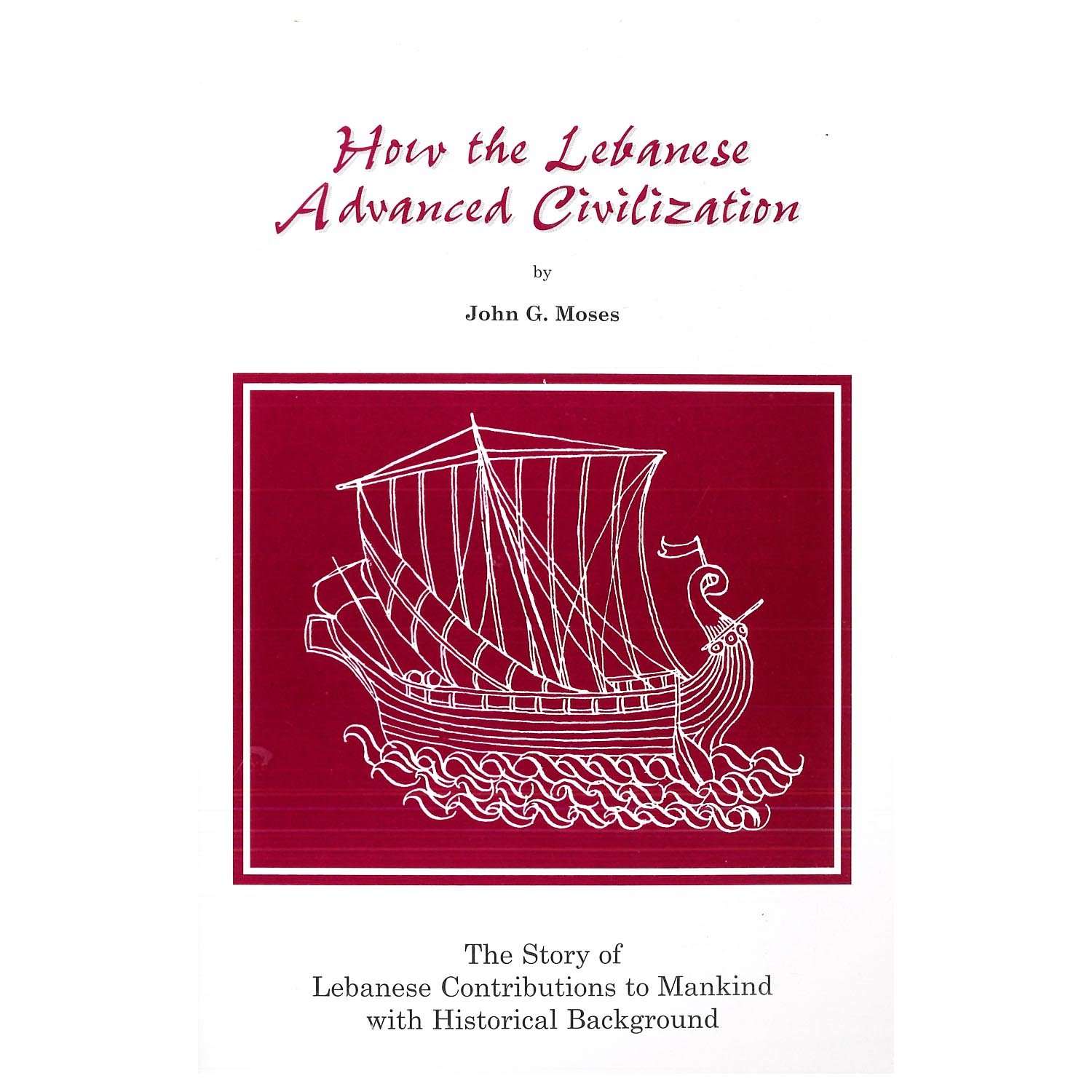
How the Lebanese Advanced Civilization: The Story of Lebanese Contributions to Mankind with Historical Background
by John G. Moses.
The book is about Lebanese history and the contributions of Lebanese people and their descendants to civilization and world culture. It is approximately 139 pages long.
Publisher: John G. Moses / Beacon Press (listed in library records)
Publication year: 1997
Length: 139 pages
The book is relatively rare, and covers:
1. Lebanon’s Geography and Its Impact on Civilization
Moses begins by arguing that Lebanon’s location on the eastern Mediterranean made it a natural crossroads of trade, ideas, and cultures. The mountains, coast, and position between larger empires shaped the character of the Lebanese people.
2. Prehistoric Lebanese Sow the Seeds of Civilization
This chapter traces the earliest inhabitants of the region and their role in the development of agriculture, settlement, commerce, and early urban life in the Near East.
3. The Phoenicians Play a Major Role in Advancing Civilization
The author highlights the Phoenicians, whom he presents as the ancestors of the Lebanese. Topics likely include maritime trade, shipbuilding, colonization, and especially the alphabet, which influenced Greek and later Western writing systems.
4. The Lebanese Progress Despite Harassment by Ancient Empires
This chapter examines how the people of Lebanon maintained their identity and commercial importance while under the influence or domination of empires such as the Assyrians, Babylonians, Persians, and others.
5. Lebanese Join the Greeks and Romans in Civilizing the Ancient World
Moses discusses the Hellenistic and Roman eras, emphasizing Lebanese cities such as Tyre, Sidon, and Berytus (Beirut) and their contributions to law, commerce, education, and culture.
6. The Lebanese Embrace Christianity and Spread the New Faith
The focus shifts to the early Christian period. The author explores Christianity’s growth in Lebanon and the role of Lebanese communities and clergy in preserving and spreading Christian traditions.
7. The Syriac Language of the Lebanese Advances Civilization
This chapter emphasizes Syriac as a language of scholarship and religious literature. Moses argues that Syriac-speaking scholars preserved and transmitted important intellectual traditions.
8. The Arabs Advance Civilization with the Help of the Lebanese
The author presents Lebanese and Syriac Christian scholars as important contributors to the Islamic Golden Age, particularly through the translation of Greek scientific and philosophical works into Arabic.
9. Lebanese Play a Vital Role in the Contest Between Cross and Crescent
This chapter covers the medieval period, including interactions among Christians, Muslims, Crusaders, and regional powers. The emphasis is on Lebanon’s strategic and cultural role.
10. Despite the Ottoman Yoke, Lebanon Moves Ahead
Moses examines Ottoman rule, describing both the limitations imposed on Lebanon and the resilience of its communities, educational institutions, and commercial networks.
11. Lebanese Acquire a Gallic Layer of Culture
This chapter discusses French influence, particularly during the Mandate period. Topics likely include education, language, law, political institutions, and cultural exchange.
12. Independent Lebanon Advances Despite Strife
The author reviews Lebanon after independence, highlighting economic growth, education, entrepreneurship, and cultural achievements while acknowledging political tensions and conflict.
13. Lebanese Bring Near Eastern Culture to the Shores of America
This chapter focuses on Lebanese immigration, especially to the United States. Moses describes the contributions of Lebanese Americans in business, religion, politics, education, and community life.
14. A Long Glance Backward
A reflective chapter summarizing the historical contributions that the author believes Lebanon and the Lebanese people have made to world civilization.
15. A Short Glimpse Ahead
The concluding chapter offers the author’s thoughts on Lebanon’s future and the continuing role of the Lebanese diaspora around the world.
Appendices
The book includes several appendices on the Lebanese/Syro-Lebanese community in Utica, New York, pioneer families, church records, historical dates, maps, and an index.